How Longevity Pet Treats Support Your Senior Dog's Golden Years
Watching a dog slow down is one of the harder parts of being a pet owner. The dog who once bolted after every tennis ball now takes the stairs one at a time. The leap onto the sofa becomes a hesitant front-paw shuffle. I have been through it with my own Labrador, and I have seen it in the dogs of friends and clients. The impulse is to reach for something that promises to turn back the clock. But the truth is more nuanced. Real support for an aging dog comes from consistent, targeted nutrition rather than any single miracle product.
That is where the category of nutraceuticals for pets has become genuinely useful. Over the past few years, products that combine traditional joint-support ingredients with plant-based compounds have moved from fringe to mainstream. One such product line gaining attention is Longevity Pet Treats, which blends familiar nutraceuticals with hemp-derived compounds. The premise is straightforward: deliver active ingredients in a form that dogs actually want to eat, and do it in a way that addresses the multiple systems that decline with age.
What Actually Changes as Dogs Age
Senior dogs face a cascade of physiological shifts. Joint cartilage thins, synovial fluid becomes less effective at cushioning movement, and chronic low-grade inflammation settles into tissues. The liver and kidneys, which filter metabolic waste and process medications, become less efficient. Cognitive function can decline, and the gut microbiome, which influences everything from immunity to mood, loses diversity.
A dog with hip dysplasia or arthritis is not just stiff. The discomfort changes how they interact with the world. They may stop wanting walks, which leads to muscle loss and weight gain, which worsens joint strain. It is a feedback loop that nutrition can interrupt, provided the right compounds are present and bioavailable.
The Ingredients That Matter Most
When I look at a pet supplement, I check for a few key categories: anti-inflammatory agents, joint-structure support, gut health, and antioxidants that buffer cellular damage. Longevity Pet Treats includes several of these, but the real value is in how they are combined.
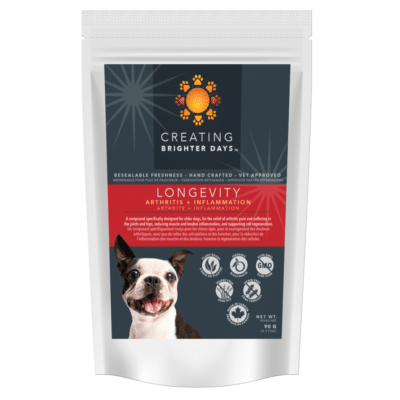
Turmeric and Cannabidiol for Inflammation
Turmeric has a long track record in human nutrition for its ability to modulate inflammation, but its bioavailability is poor unless paired with black pepper or a fat source. In a treat matrix, that pairing happens naturally. Cannabidiol, or CBD, works through the endocannabinoid system, which exists in dogs just as it does in humans. CBD does not get a dog high. It interacts with receptors that regulate pain perception and immune response. When combined with turmeric, the anti-inflammatory effect can be more sustained than either ingredient alone.
Terpenes, the aromatic compounds found in hemp and other plants, also play a supporting role. Some terpenes have been shown to reduce oxidative stress in joint tissues. The synergy between CBD, terpenes, and turmeric is not just marketing copy. It mirrors what researchers see in human studies: the whole-plant extract often outperforms isolated compounds.
Glucosamine and Chondroitin for Joint Structure
These two are the old guard of joint health, and for good reason. Glucosamine is a building block of cartilage. Chondroitin helps cartilage retain water, keeping it spongy and resilient. In senior dogs with arthritis, supplementation with glucosamine and chondroitin has been linked to improved mobility and reduced pain medication needs. The key is consistency. These are not fast-acting compounds. They need to accumulate in joint tissue over weeks.
What I appreciate about the formulation in Longevity Pet Treats is that glucosamine and chondroitin are not the only joint support on offer. They are paired with omega-3 fatty acids, which reduce the inflammatory environment that degrades cartilage in the first place. Omega-3s also support kidney function and cognitive health, making them a multi-target ingredient.
Probiotics and Digestive Health
Gut health is often overlooked in senior dog care. As dogs age, their digestive enzyme production drops, and the balance of gut bacteria shifts. Probiotics help maintain a diverse microbiome, which supports immune function and can reduce systemic inflammation. Some probiotics also produce short-chain fatty acids that nourish the cells lining the gut, improving nutrient absorption. If a dog cannot absorb the glucosamine or turmeric, those ingredients do little good. Probiotics help ensure the treat delivers on its promise.
How Hemp and CBD Fit Into the Picture
Hemp is a source of both CBD and omega-3s, but it also provides fiber and other phytonutrients. In the context of pet treats, hemp-derived CBD is appealing because it is non-psychoactive and well tolerated by dogs. The legal status of CBD for pets varies by region, but in places where it is permitted, it has become a staple for managing anxiety and joint discomfort.
Kush Station, the retailer behind this product line, positions itself at the intersection of cannabis, hemp, and pet wellness. That might sound unusual, but the logic is consistent. The same compounds that help humans manage stress and inflammation can help dogs, albeit at different dosages and with careful attention to the absence of THC. The treats use broad-spectrum hemp extract, meaning they retain the full range of cannabinoids and terpenes rather than isolating CBD alone. This is important because the entourage effect, where multiple cannabinoids work together, often produces better results than CBD in isolation.
What the Science Says
I want to be careful not to overstate what we know. The research on cannabinoids for dogs is still in its early stages. Most studies are small, and many rely on owner-reported outcomes rather than objective measures. That said, the existing evidence is encouraging. A 2020 study on dogs with osteoarthritis found that those given a CBD-rich hemp extract showed significant improvement in comfort and activity levels compared to placebo. Similar studies in humans support the anti-inflammatory mechanism.
Turmeric, glucosamine, and chondroitin have stronger evidence bases, with multiple controlled trials in both humans and dogs. The challenge is dosage. Many commercial pet treats contain only trace amounts of these ingredients, enough to appear on the label but not enough to produce a physiological effect. Longevity Pet Treats appears to dose at levels that align with veterinary recommendations, though I always advise pet owners to check the milligram content per treat and compare it to their dog's weight.
Practical Advice for Pet Owners
If you are considering adding a nutraceutical treat to your senior dog's routine, here are a few things I have learned from experience and from talking to veterinarians.
- Start with one product and give it at least four weeks before judging results. Joint supplements take time to build up in tissue.
- Watch for changes in behavior, not just physical ability. A dog that seems more relaxed or sleeps more soundly is benefiting even if the leaps are not yet returning.
- Check for interactions if your dog is on medication. CBD can affect liver enzyme activity, which may alter how other drugs are metabolized.
- Store treats properly. Hemp-derived compounds can degrade with heat and light. A cool, dark cabinet is better than a pantry near the stove.
I also recommend keeping a simple journal. Note the date, the treat dose, and any observations about mobility, appetite, and demeanor. It is easy to forget subtle improvements over a month. Writing them down gives you concrete data to share with your vet.
Beyond the Treat: A Holistic Approach
No treat, no matter how well formulated, replaces the basics. Senior dogs need appropriate exercise, weight management, and regular veterinary checkups that include bloodwork for liver function and kidney support. Joint health is closely tied to body weight. Every extra pound adds roughly four pounds of force across the joints. Keeping your dog lean is one of the most effective ways to preserve mobility.
That said, a well-designed nutraceutical treat can fill gaps that diet alone cannot cover. Most commercial dog foods, even premium ones, do not provide therapeutic levels of glucosamine or CBD. Treats allow you to target specific needs without changing your dog's entire diet. Longevity Pet Treats, with its blend of turmeric, CBD, glucosamine, chondroitin, probiotics, and omega-3 fatty acids, offers a broad-spectrum approach that addresses inflammation, joint structure, gut health, and oxidative stress in one product.
The Bottom Line
I have seen enough dogs regain a spring in their step after a few months on a good supplement to believe in the approach. But I have also seen owners expect too much too fast and give up when the results are not dramatic. The real win is slower: a dog that climbs stairs without hesitation, a dog that greets you at the door with a wag instead of a wince. Those small victories add up to a better quality of life in the final years.
If you are looking for a starting point, Longevity Pet Treats is worth considering. It combines established joint-support ingredients with the newer science of hemp-derived cannabinoids, and it comes from a retailer, Kush Station, that understands the broader context of plant-based wellness. Just remember that supplements support, they do not replace. Good nutrition, appropriate exercise, and attentive veterinary care remain the foundation. The treat is the extra layer that can make the golden years genuinely golden.
Corrections
Spot something wrong? Send it to the desk and it gets fixed in the open.